












Financing Resilience: The Untapped Adaptation Potential of CDR
In this first edition of GFI Insights series, we examine how CDR business models are adapting to evolving policy, corporate and investor signals and how it offers valuable, timely adaptation and resilience co-benefits for nature and people.
Our Transactions to Transitions approach is a scalable greenprint that brings the whole system together by:
- Connecting country demand with investment supply
- Aligning policy, development capital and project pipelines
- Turning opportunities into investable deals
- Building institutional approaches that allow solutions to be replicated and scaled across sectors and geographies
By focusing relentlessly on execution, testing ideas, breaking down barriers and co‑designing solutions, GFI enables governments, business and finance to work together to unlock real‑economy investment that delivers public value.
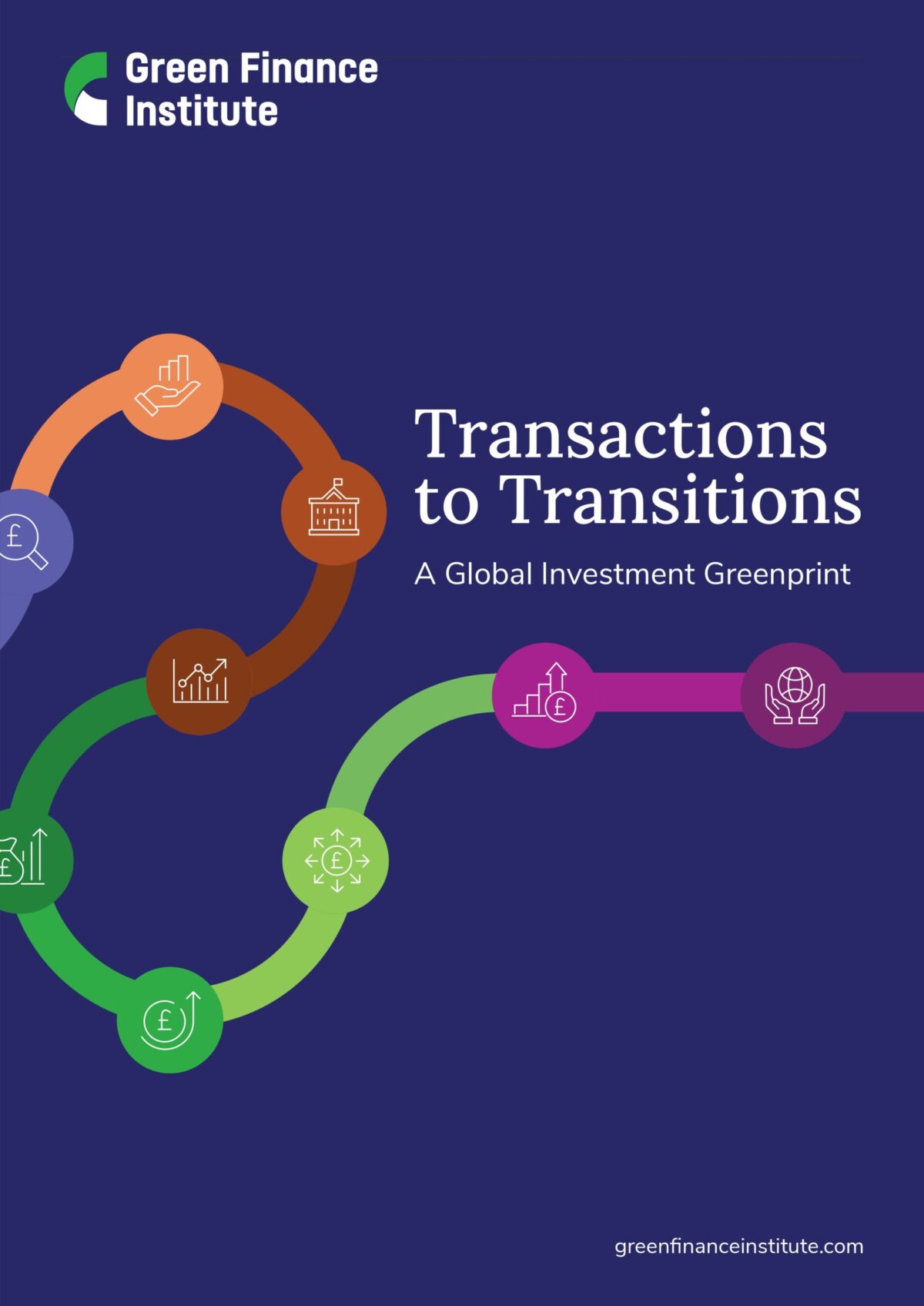
Transactions to Transitions: A Global Investment Greenprint

Establish a national goal
Set a clear national goal. This gives investors and developers the certainty they need to commit resources. Goals must reflect fiscal realities and consumer capacity, so funding and financing remain sustainable. Broad support reduces the risk of sudden policy shifts. Sector goals should complement wider national objectives — for example, an energy grid plan in energy markets or a restoration framework in nature markets.

Policy and regulation
Strong legal frameworks and support for private ownership reduce risk as does the embedding of decarbonisation goals in legislation. Predictable taxes, capital movement, and macroeconomic stability give confidence, especially to foreign investors. Clear planning and land-use rules help developers secure land and start projects quickly. These conditions lower risk and unlock private capital.

Incentives to create demand + supply
Investors need confidence that demand exists, and revenues are secure. Utility-scale projects rely on contracts like Power Purchase Agreements, while household-level demand may need pricing support. Too much supply before demand matures risks stalled pipelines and government intervention. In newer sectors, such as green hydrogen, subsidies and off-taker agreements are essential to create demand and close the cost gap with conventional products.

Sector and market infrastructure
Predictable, timely procurement keeps bids realistic and projects on track. Delays push developers and investment teams to other markets. Repeatable processes encourage investment in supply chains, manufacturing, and jobs. Standard contracts, such as Power Purchase Agreements, reduce negotiation time. Consistency also builds an ecosystem of advisers, financiers, and legal experts, as repeat business justifies ongoing commitment of resources.

Building institutions
Build capacity within key institutions. Strong institutions are essential where enabling environments are less mature. Bringing public and private sectors together can help identify and remove barriers to project delivery. In some cases, the priority may be creating an independent procurement agency to run repeat auctions. This shift can move a market from isolated projects to a sustainable, long-term programme.
Project pipeline
Develop the project pipeline. With national goals, stable policies, and reliable procurement, private developers and investors will engage. As confidence builds through repeat bidding and delivery, projects can scale into full programmes. In early-stage markets, grants and development finance can play a key role by funding feasibility studies and due diligence. Referencing national plans helps reassure investors that opportunities are real and worth pursuing.

Product innovation
Develop new products, funds and market interventions that directly address de-risking requirements, allow for risk-sharing, credit-enhancement, demand-side certainty and capital protection. These products can be designed with providers of public, development or private capital depending on sector specific requirements and geographic nuance.

Public capital / FOAK Pilots
Deliver financial products with public or first-of-a-kind (FOAK) capital. In markets with limited lending capacity, DFI support can unlock early projects and stimulate local finance. Currency risk may also need coverage until markets mature. Programmatic risk-mitigation facilities can speed projects to financial close. For example, South Africa’s Green Finance Facility uses limited public capital to guarantee deals, making municipal renewable energy and infrastructure projects bankable for private investors.

Blended Finance
Introduce private capital into capital stack. As project pipelines expand and payment and regulatory histories become clearer, private investors gain confidence in assessing risk. Reliance on concessional finance can be reduced or removed. Greater familiarity and trust in the market allows private capital to flow faster and at larger scale, accelerating overall investment and programme growth.

Scale products into asset classes
Scale financial products into local markets. As programmes grow, new financial products develop. In countries with stronger financial systems, local pension funds and other investors can become long-term owners of operating projects. Building these domestic investment channels makes financing more sustainable and helps projects grow faster.

Turn domestic into global asset classes
Scale domestic asset classes into global markets. As markets mature, projects and companies can attract international investors alongside local capital. Strong track records and larger portfolios make it easier for investors to access the asset class. This also allows greater diversification across locations, project types, and jurisdictions, increasing confidence and supporting further investment growth.
- Policy
- Market infrastructure
- Product development
- Replicate and scale
Latest News and Insights

Financing Resilience: The Untapped Adaptation Potential of Carbon Dioxide Removal
Carbon dioxide removal (CDR) is a critical climate change mitigation lever alongside efforts to...

From Transactions to Transitions: GFI Indonesia and PT SMI Kick Off Technical Assistance for Indonesia’s First Development Trust Fund
Building on earlier work to develop the concept and design of a Development Trust...

GFI launches new Transition Finance Lab to drive investment into UK infrastructure, economic transition and growth, and support first-of-a-kind projects
GFI Transition Finance Lab, which is delivered in partnership with DESNZ will bring project...
GFI products and services

Climate Strategy
Analysis on priority sectors and associated finance roadmaps to move towards the creation of investable NDCs

Policy Frameworks
Advice on creating mandates and incentives, including revenue certainty mechanisms, carbon pricing and public capital strategies

Institutional Design
Designing effective institutional approaches to aligning policy and regulation with the needs of private capital

Product Design
Working directly with development finance and private capital to design new product innovations to support capital flow

Innovation Pilots
Go-to-market strategies for new products to test regulatory treatment, policy incentives and investor appetite

FOAK investment readiness
We provide expert support to help First-of-a-Kind (FOAK) projects become investment-ready, including strategic advice on preparing projects for funding

Advisory & consulting services
We offer strategic guidance to corporates and financial institutions on strategies to deploy capital into net-zero and nature positive projects, improving supply chain resilience and unlocking competitive advantages, alongside product development and validation services

Training
We deliver tailored training programmes for corporates, financial institutions, philanthropic organisations, and the public sector, focused on investing in sectoral transitions

Coalition Building
We convene diverse stakeholders to tackle systemic challenges, creating sector-wide coalitions that drive practical solutions. From the Coalition for the Energy Efficiency of Buildings (CEEB) to emerging partnerships, we unite finance, industry, and policymakers to accelerate change.
Our Funders
The Green Finance Institute is grateful for the support and funding we receive from: